
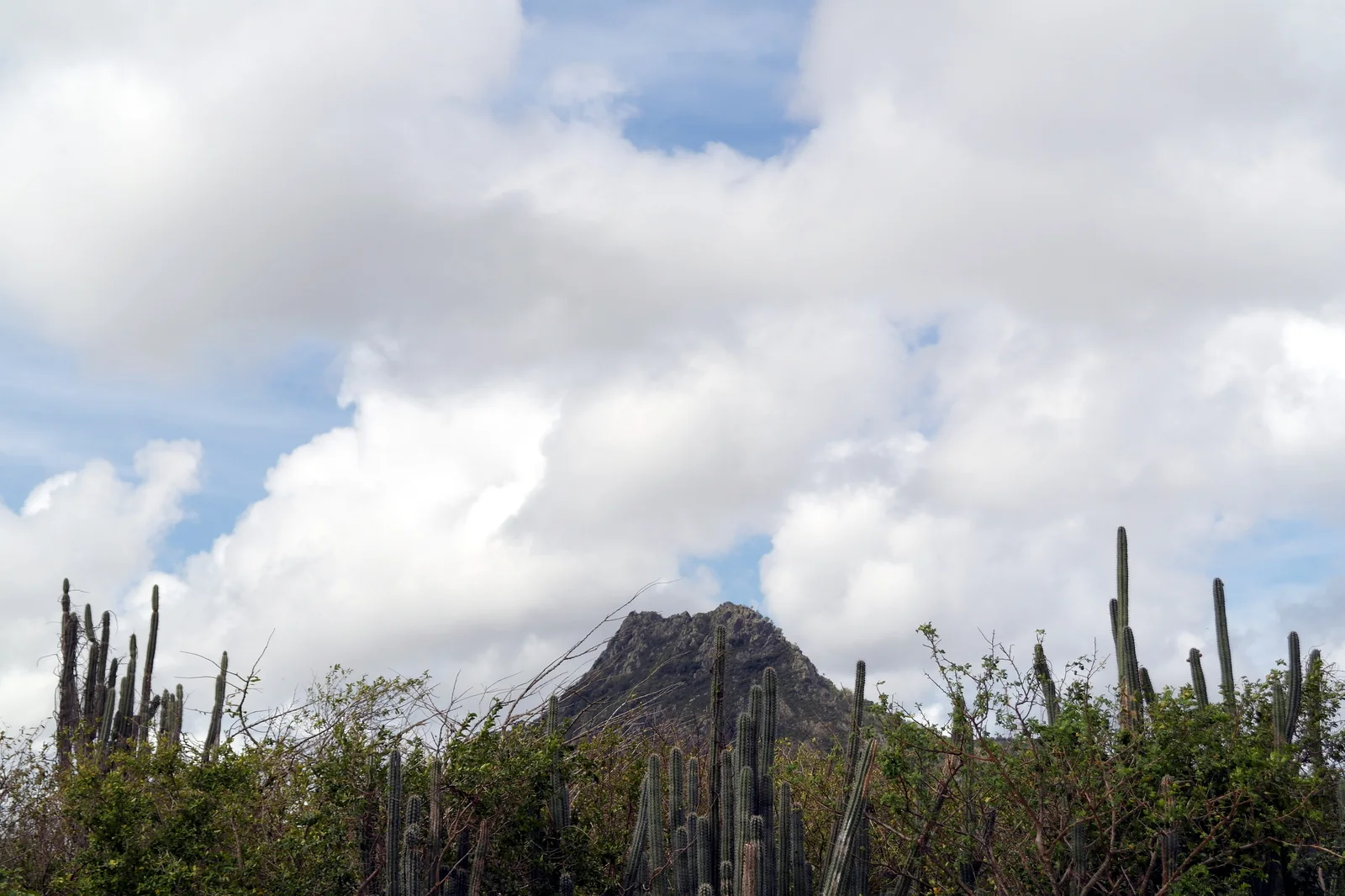
Step off the plane near Willemstad expecting damp tropical jungle, and Curaçao corrects that assumption before you clear the airport fence. Sitting roughly 60 kilometers (37 miles) north of Venezuela on the South American continental shelf at 12°N latitude, the island stretches 64 kilometers across roughly 444 square kilometers (171 sq mi) of sun-baked rock, red volcanic clay, and cactus scrub. Mount Christoffel (Christoffelberg) lifts the northwest corner to 372 meters (1,220 feet), yet most of the island stays dry, open, and stripped by constant Atlantic airflow.
Hardly anyone plans an off-road day by checking rock maps first. Still, underlying stone controls everything you feel through handlebars or a steering wheel. Willemstad and the deep natural channel of St. Anna Bay and Schottegat split the island neatly into two riding zones: windward Banda Ariba to the east and hillier, greener Banda Abou stretching northwest. Compare routes on our Curaçao ATV and buggy hub, then filter active operators in the verified tour catalog once you match your comfort level to the rock underfoot.
Island Terrain & Off-Road Rules at a Glance
- Two Distinct Rock Layers: Inland red dirt basins on the Curaçao Lava Formation shift sharply into jagged Seroe Domi and Pleistocene fossil-coral shelves along coastal bluffs.
- Leeward Calm vs. Windward Spray: Sheltered western coves (Daaibooi, Kokomo, Grote Knip, Cas Abao) suit post-dust swims; north-coast Playa Kanoa and Sint Joris Baai take heavy surf and steady gusts.
- Strict National Park Bans: CARMABI prohibits quads, ATVs, motorcycles, and buggies inside Christoffel National Park ($15.00 USD (~€13.80) / ANG 25.00) and limits Shete Boka ($15.00 USD (~€13.80) / ANG 26.25) to marked roads and decks.
- Xeric Flora Hazards: Expect tight corridors lined with kadushi cacti, southwest-bent watapana trees, and toxic coastal manchineel (mansaliña) sap.
- Zero Marine Souvenirs: Exporting coral rubble, beach rocks, sand, or protected shells like Queen Conch triggers airport confiscation and heavy fines.
Dual Geology: Cretaceous Basalt Basins and Coral Reef Shelves
Not many travelers realize how sharply two rock layers divide a single three-hour ride. Beneath Curaçao’s interior valleys lies the Curaçao Lava Formation, a deep volcanic sequence born under ocean water roughly 90 million years ago during the Cretaceous period. Thick pillow basalts and weathered volcanic diabase sit exposed where erosion stripped newer limestone away, particularly across Tera Kora, the Hato Plains, San Pedro, and inland hills behind Sint Joris Baai.
Down inside those basins, diabase decomposes into rust-colored red clay, coarse gravel, and powdery silt flats. Dry months from February through June turn that clay into talcum-fine plumes that choke rear-of-convoy riders within five minutes. Then October arrives. Overnight or dawn showers from October through January pool inside low basin tracks, flipping hard dust pans into slick clay mud and deep ruts that sling red splatter high onto shins and roll cages. Check seasonal surface patterns in our best time and weather breakdown before locking in a morning or afternoon slot.
Climb toward the island perimeter, and volcanic clay vanishes under uplifted Seroe Domi formations and fossilized Pleistocene coral terraces. As tectonic forces raised the seafloor across changing ice-age ocean levels, ancient reefs hardened into dense, sharp-edged limestone benches ringing the shore. Tires hit that fossil stone with a completely different vibration. Zero give exists when a quad drops off a pocketed coral shelf near Boca Patrick or Ronde Klip, sending sharp jolts straight into wrists unless a buggy’s longer coil-over shocks absorb the chatter (our ATV quad vs UTV buggy comparison breaks down suspension differences in detail).
Acidic rainwater slowly hollowed subterranean pockets through those same coral benches, creating two very different cavern experiences for visitors:
- Wild Unlit Trail Grottos (Kueba di San Antonio and Indian Cave): Western ATV and UTV tours such as
GYG-512961($115.00 (~€105.80)) and401926P1($103.50 (~€95.22)) pull off San Pedro dirt spurs at undeveloped limestone caverns like Kueba di San Antonio and Indian Cave (Kueba di Indjan). You step off hot vehicles onto uneven stone floors beneath hanging stalactites, darting fruit bats, and faint pre-Columbian Caiquetio rock markings with zero boardwalks or floodlights. - Ticketed Show Caverns (Hato Caves): Positioned on F.D. Rooseveltweg near Curaçao International Airport (
12.1798, -68.9484), Hato Caves operates as a standalone paid heritage site ($10.00 USD (~€9.20) adults, $8.00 USD (~€7.36) children ages 4 to 12, free ages 0 to 3; hourly 45- to 50-minute guided walks daily from 9:00 AM to 3:00 PM). Commercial off-road convoys do not route down Hato’s paved stairs.
Windward Atlantic Cliffs vs. Sheltered Leeward Coves
Sitting outside the main Atlantic hurricane belt shapes coastal riding every day of the year. Per Meteorological Department Curaçao (MDC) records, steady easterly to northeasterly trade winds hold at Beaufort Force 4 to 5 (roughly 20 to 39 km/h, gusting harder on open northern headlands), keeping daytime highs around 28°C to 32°C (82°F to 90°F) bearable whenever vehicles stay moving. Where those winds strike rock creates two completely opposing shorelines.
Along the Windward north and east coast (Banda Ariba), heavy Atlantic swells crash head-on against sheer fossil-coral shelves. Salt mist hangs permanently in the air around Playa Kanoa (12.1722, -68.8631) and northern Boca Patrick, forcing white plumes skyward through pressurized blowholes (supladó) and beneath eroded stone overhangs. Only small local fishing boats shelter inside Playa Kanoa’s rough pocket landing. Casual ATV tour swims are unsafe along this exposed rim due to vicious shorebreak, sharp submerged coral rock, and rip currents, though broad windward flats at Sint Joris Baai (12.1198, -68.8158) give kitesurfers steady gusts and offer wide dirt perimeter tracks explored in our East Coast Banda Ariba guide.
Turn onto the Leeward south and west coast (Banda Abou), and the Caribbean turns quiet as a swimming pool. Protected by the island’s rocky spine, calm turquoise coves tuck neatly between low limestone headlands:
- Daaibooi Beach (
12.2122, -69.0844): Free-access public cove bordered by rocky snorkeling ledges; serves as the signature swim cooldown on Curaçao Activities’ 3.5-hour UTV tours (GYG-1573390and207794P3at $229.00 (~€210.68) per 2-seat vehicle). - Kokomo Beach (Vaersenbaai): Lively leeward bay closer to Willemstad with shore access, casual food service, and shade trees, anchoring Kadushi By Spannerben’s UTV run (
GYG-876904at $193.50 (~€178.02) per 2-seater). - Grote Knip (Playa Kenepa Grandi): Free public bay framed by towering clifftops farther west, famous for electric-blue water rather than ATV staging.
- Cas Abao Beach: Broad white coral-sand curve operating with a small per-car entry fee, loungers, showers, and dive facilities for independent rental-car days.
Honestly, even paved connectors between those coves hold a sneaky geological trap. Island road crews mix crushed coral limestone into local asphalt, which polishes smooth under rubber tires and becomes slick as oiled slate during brief morning showers. Keep extra braking distance on paved links and review our Curaçao ATV safety and traffic guide before turning onto public streets.
Cactus Scrub, Trade-Wind Trees, and Coastal Wildlife
Receiving only 500 to 600 millimeters of annual rainfall places Curaçao inside the Guajira-Barranquilla xeric scrub biome, shared closely across the ABC chain. Instead of banana palms or vine thickets, trails weave past thorny scrub evolved to survive relentless sun and salt spray. Towering columnar kadushi cacti (Cereus repandus), branching prickly pear (Opuntia), and squat barrel Melocactus crowd narrow single-track lanes across Ronde Klip and Tera Kora, snagging bare forearms or cheap sandals whenever riders drift off line. Check mandatory footwear and eyewear rules on our what to wear and pack checklist before boarding your quad.
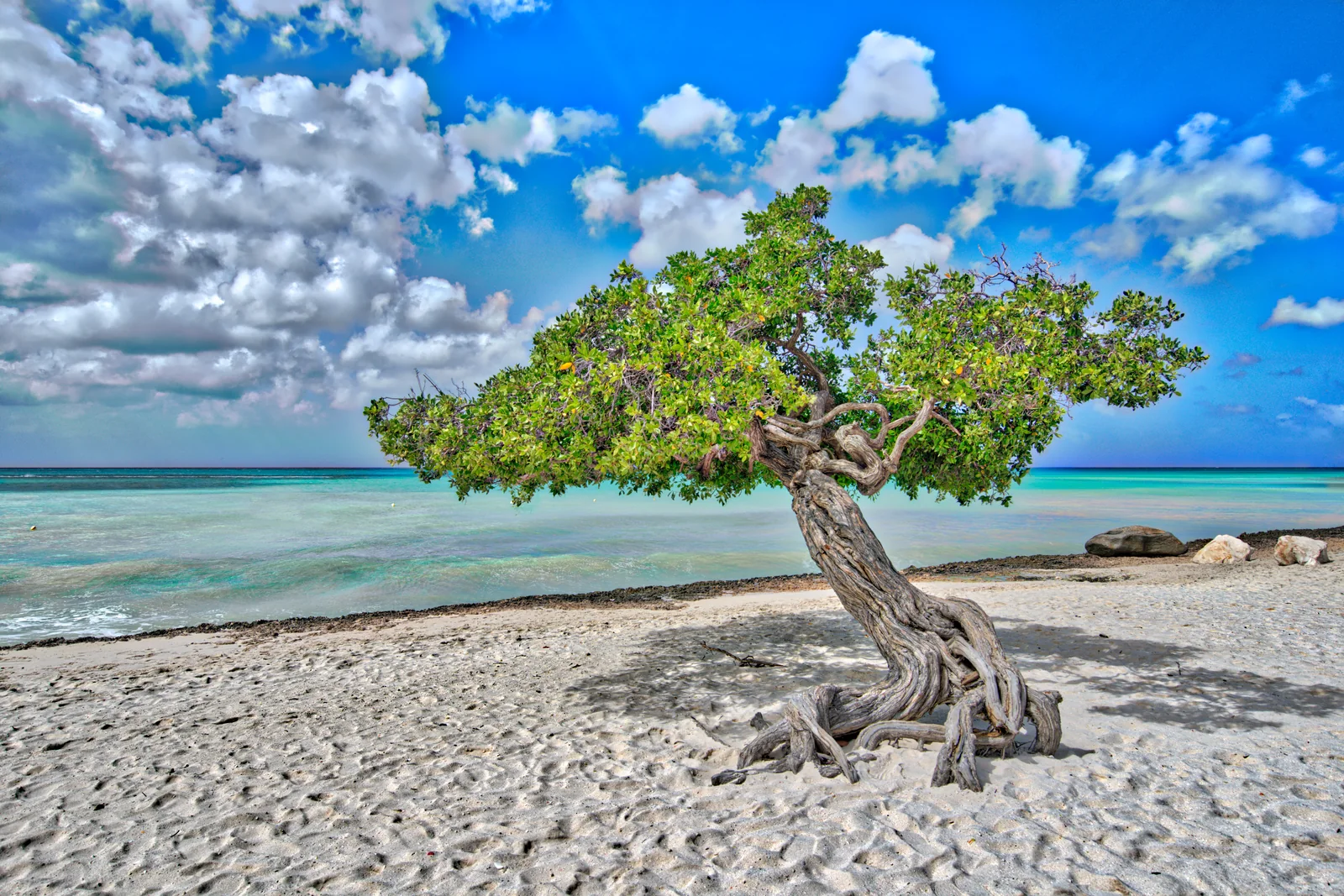
Above the cacti stand Curaçao’s natural wind vanes: divi-divi trees (Libidibia coriaria, known locally in Papiamentu as watapana). Years of relentless northeast trade winds force every branch and crown to grow permanently southwest, pointing riders straight toward the leeward sea even on overcast mornings. Just watch closely near beach parking edges for a far less friendly coastal tree. Glossy green manchineel (mansaliña, Hippomane mancinella) grows sporadically along sheltered coves, bearing small crabapple-like green fruit. Every droplet of its milky sap blisters human skin and burns eyes badly; never duck beneath a manchineel canopy during a rain shower or snap low branches while maneuvering a buggy.
Wildlife spots require quiet patience once engines cut off at viewpoints. Over at Jan Kok Salt Flats (Salina Jan Kok, 12.2310, -69.0790) in Banda Abou, shallow pink evaporation pans draw wild Caribbean flamingos (chogogo) feeding on brine shrimp right alongside dry perimeter dirt roads. Convoys park strictly on hard embankments here because salt mud swallows tires past the axles and wrecks protected feeding habitat. Elsewhere along warm coral ledges and stone ranch walls, native green iguanas (yuana, Iguana iguana, with dominant males turning vivid orange between January and March) bask undisturbed beside lightning-fast turquoise whiptail lizards (blò-blò). Offshore in calm inlets like Boka Ascension and rocky northern coves, Green (Chelonia mydas), Hawksbill (Eretmochelys imbricata), and Loggerhead (Caretta caretta) sea turtles glide beneath surface swells, nesting on sheltered pocket sands mainly from May through December.
National Park Bans, Legal Trails & Terrain Zones Table
Few visitors verify boundary maps before booking, yet CARMABI (Caribbean Research and Management of Biodiversity) enforces strict motorized limits across Curaçao’s major terrestrial reserves. Both flagship parks in the northwest bar ATVs and commercial buggies completely.
Inside Christoffel National Park, open daily from 6:00 AM to 2:00 PM (gate tickets close strictly at 1:30 PM, hiking Mount Christoffel is allowed only before 10:00 AM, and visitors must carry at least two liters of water), official regulations read verbatim: “No motorcycles, buggies, ATV’s or quads allowed in the park.” Entry runs $15.00 USD (~€13.80) / ANG 25.00 for international adults ($4.50 USD / ANG 7.50 for ages 6 to 12, free under age 6, ANG 5.00 local residents) and allows only enclosed cars, SUVs, foot hikers, or park-sanctioned Jeep tours along scenic loops. Drones, smoking, pets, open fires, and loud music are prohibited too.
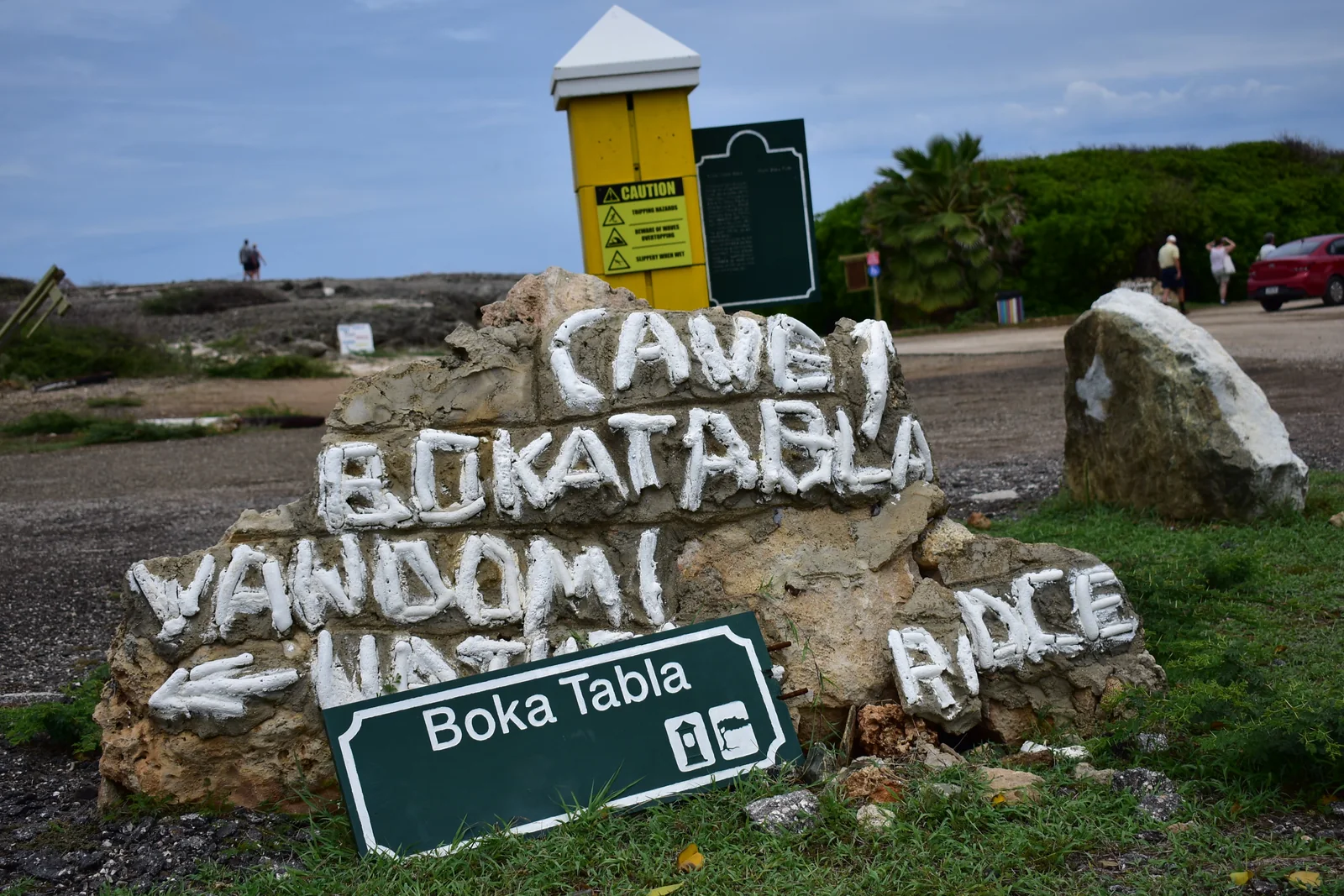
Nearby Shete Boka National Park runs daily from 8:00 AM to 4:00 PM (last booth admission 3:00 PM, $15.00 USD (~€13.80) / ANG 26.25 adults, roughly $2.00 USD / ANG 3.50 ages 6 to 12, free under 6). Motor vehicles must stay strictly on marked passenger-car tracks and parking spurs, while visitors walk foot trails and wooden overlooks above sea-turtle nesting inlets like Boka Pistol, Boka Tabla, and Boka Kalki. Driving across the jagged fossil-coral plateau or building stacked rock cairns violates park law.
Instead of entering protected reserves, licensed operators in our West Coast Banda Abou guide and eastern routes keep tires on public rural dirt rights-of-way, municipal gravel tracks, and contracted private ranch land. Here is how each zone actually rides:
| Island Zone / Protected Area | Dominant Geology & Surface | Dry (Feb to Jun) vs. Wet (Oct to Jan) | Off-Road Legality & Access Rule |
|---|---|---|---|
| Hato Plains & San Pedro | Weathered Cretaceous basalt clay, gravel flats, wind-farm spurs | Dense red mineral dust clouds vs. sticky clay puddles and ruts | Legal Guided Trails: Primary West corridor for GYG-512961, GYG-876904, 5535072P4 |
| Tera Kora & Ronde Klip | Mixed volcanic diabase hills, loose stone climbs, kadushi scrub | Hard dry pack and loose gravel vs. rutted hillside washouts | Legal Guided Trails: Rural dirt bypasses city traffic (GYG-1137091, East routes) |
| Sint Joris Baai Perimeter | Flat tidal silt edges, compressed coral-sand dirt, mangrove scrub | Windblown grit across wide lanes vs. boggy wet shoreline silt | Legal Guided Trails: Core Banda Ariba track (9023P1, 362410P11, GYG-481716) |
| Playa Kanoa & Boca Patrick | Pitted Seroe Domi fossil-coral shelves, sharp ledges, blowholes | Harsh glare and steady salt spray vs. wet slick reef rock | Legal Edge Viewpoints: No casual swimming; stay clear of wet blowhole rims |
| Jan Kok Salt Flats | Soft hypersaline mudflats fringed by hard gravel perimeter tracks | Dusty roadside pull-offs vs. axle-deep mud traps off-road | Perimeter Only: Driving onto salt pans is illegal and destroys flamingo feeding |
| Christoffel National Park | Volcanic basalt peaks, chert ridges, dry tropical forest slopes | Hot dusty climbs vs. steep slick mountain footpaths | ATV/Buggy Ban: Enclosed cars, SUVs, hikers, and park-sanctioned Jeeps only |
| Shete Boka National Park | Jagged coastal coral-limestone plateau, sea caves, turtle bokas | Fierce sun glare off white rock vs. slippery salt-wet ledges | No Off-Roading: Cars on marked roads only; foot access to cliff decks |
Terrain Traps & Park Enforcement Warnings
- “Westpoint” Tour Listings Never Mean Inside Christoffel: Operators using Westpoint labels (such as
362410P8at $100.00 (~€92.00)) ride rural San Pedro and coastal ranch tracks outside CARMABI park boundaries; no commercial ATV tour legally enters Christoffel or Shete Boka interiors. - Salt-Pan Tire Sinkholes: Never pull off gravel berms beside Salina Jan Kok for a closer flamingo angle. Hypersaline silt swallows heavy quads immediately and carries steep environmental fines.
- Slick Wet Coral Limestone: Even brief dawn showers polish coral-aggregate paved roads and wet coastal reef shelves into ice-slick hazards.
- Manchineel Rain-Shelter Trap: Seek open sky or roofed UTV cages rather than standing under shady green beach trees (mansaliña) when passing clouds drop rain.
- Marine Contraband Checks: Do not pocket dead coral fragments, sand, or shells along trail stops; departure customs enforces strict export bans.
Curaçao vs. Aruba Off-Roading & Conservation Export Rules
Travelers bouncing between the Dutch Caribbean islands often ask whether Curaçao rides like neighboring Aruba. Honestly, the two islands share xeric cacti and trade-wind watapana trees, yet terrain and off-road regulations feel worlds apart once you leave pavement.
At roughly 444 square kilometers with rolling hills climbing to 372 meters (1,220 feet) on Mount Christoffel, Curaçao spans more than double Aruba’s compact 180 square kilometers (where Mount Jamanota tops out near 600 feet). Aruba’s northeastern windward side also features sweeping coastal sand dunes around Boca Prins, whereas Curaçao holds zero natural sand dunes anywhere along its shore. Off-roading here means trading soft dune bowls for firm red clay basins, rocky volcanic hill spurs, and sharp coral limestone bluffs.
Traffic density separates them even more clearly. Aruba built a massive volume industry around open-desert motorized caravans, pushing Arikok National Park authorities to ban all ATVs, buggies, and independent UTVs outright while restricting interior park lanes strictly to registered commercial UTV and 4x4 tours. Curaçao remains noticeably quieter and more decentralized. Commercial operators here spread guided loops across private East and West trail corridors (GYG-1137091 even caps departures at six quads out of Tera Kora for $218.50 (~€201.02) per group up to two, while GYG-481716 keeps East Sint Joris buggies to $170.00 (~€156.40) per vehicle), leaving Christoffel and Shete Boka completely quiet for hikers and wildlife.
One coastal rule binds every visitor tightly before flying home: leave shells, sand, and coral untouched. Under Curaçao’s nature protection laws enforced alongside CARMABI and international CITES treaties, collecting or exporting wild coral (whether alive, dead, fossilized, or broken rubble along parking areas), beach stones, sand, or protected marine shells such as Queen Conch is illegal. Security scanners at Curaçao International Airport inspect checked bags and carry-ons routinely, confiscating marine souvenirs and issuing heavy fines (with extra customs trouble awaiting passengers landing back in North America or Europe). Take photos, dust off your sneakers, and buy locally crafted goods in Willemstad instead.
Budget-minded riders without rental cars can still reach trailheads easily by planning around island transit rules. Municipal ABC Konvoi buses charge ANG / XCG 2.00 (~$1.15 USD) on East routes or ANG / XCG 2.50 (~$1.40 USD) on West routes, though infrequent rural headways make hotel pickup or pre-agreed fixed-rate TX taxis far smoother on half-day tours; check departure hubs, transit lines, and transfer times in our getting to Curaçao trailheads guide before booking your spot from $87.50 (~€80.50) per quad up to $229.00 (~€210.68) per two-seat UTV.